


Remember that panic when Bitcoin surged 15% in a day, and you frantically searched for your credit card to buy “before it’s too late”? Or that bitter moment when the market crashed 30%, and your portfolio turned into a sea of red numbers because you bought at the peak of emotions?
If you’ve ever felt FOMO (Fear of Missing Out) in the cryptocurrency market — this article is for you. Today, we’ll discuss how futures arbitrage technology helps earn 8-15% per month without needing to predict market direction, without succumbing to emotions, and without checking charts 50 times a day.
The Problem: Why 90% of Retail Traders Lose Money
FOMO — The Silent Deposit Killer
The crypto market operates 24/7, never closing for a minute. While you sleep, Bitcoin can surge 10%, and by morning your Telegram feed explodes with messages: “To the moon!”, “Buy now!”, “New cycle starting!”. Your heart races. Your hands reach for your phone. You buy at the peak — and two hours later the price drops 12%.
This isn’t a theoretical scenario. Research shows that up to 90% of retail traders lose money within their first year. The reason isn’t lack of knowledge, but emotional burnout and the impossibility of competing with professional algorithms.
Problems with Regular Trading:
1.Market Direction Dependency
You buy Bitcoin at $50,000, hoping for a rise to $55,000. But if the market reverses, your strategy collapses. You become an unwilling “long-term investor” — holding a losing position, hoping for a bounce.
2.Emotional Stress 24/7
The cryptocurrency market never sleeps. A $500 million liquidation can happen overnight, and by morning your portfolio may have lost 20%. You’re constantly tense: checking your phone at breakfast, during meetings, before bed.
3.Manual Trading Errors
Forgot to set a stop-loss? Opened a 10x leveraged position in a state of excitement? Panic-sold at a local bottom? One mistake can wipe out weeks of profits.
4.Competing with Professionals
On the other side of your trade — high-frequency algorithms from hedge funds that analyze millions of data points per second. You’re trading from your phone on the subway. Who do you think has better odds?
Educational Section: What is Futures Arbitrage (And Why It’s a Completely Different Game)
Arbitrage is Not Guessing — It’s Mathematics
Imagine you walked into Store A and saw a bottle of water costs $1.00. Then you checked Store B across the street — the same water is $1.70. You buy at Store A, sell at Store B, earning $0.70 on the difference. And you absolutely don’t care whether water becomes more or less expensive tomorrow — you’ve already captured the spread.
Futures arbitrage works the same way, just on cryptocurrency exchanges.
How Do Price Discrepancies Between Exchanges Arise?
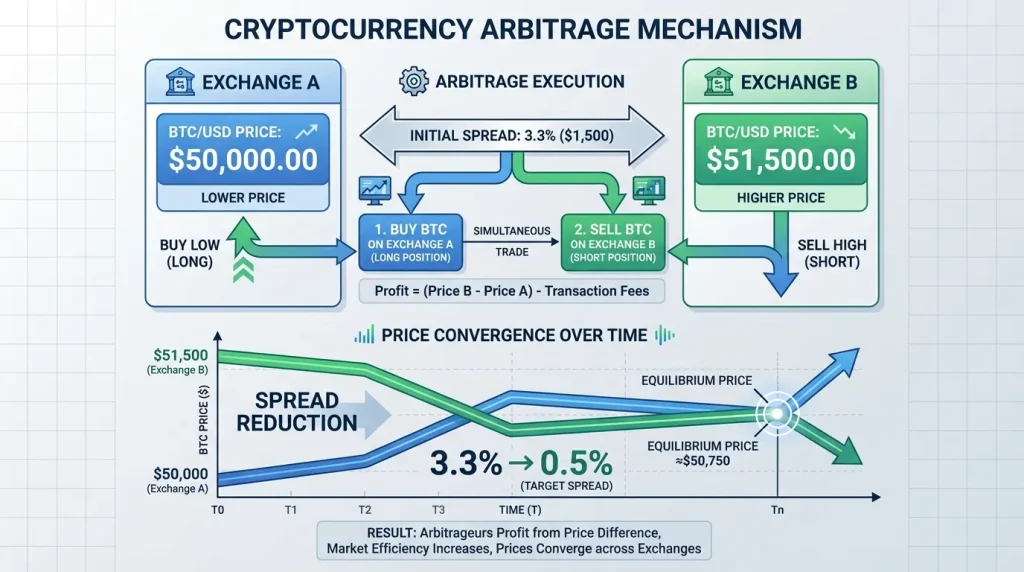
Contrary to intuition, the price of the same cryptocurrency is not identical across different exchanges. Bitcoin can be $50,000 on Binance, $51,500 on Bybit, and $49,800 on MEXC — simultaneously. Why?
1.Technical Delays
Exchanges update quotes with micro-delays. When major news hits the market (for example, Bitcoin ETF approval), exchanges react at different speeds. One exchange may react 2 seconds faster than another.
2.Liquidity Differences
Binance is the largest exchange with trillions in volume. A $10 million order won’t move the price there. On a smaller exchange, such an order can shift quotes by 3-5%.
3.Regional Peculiarities
Asia has its activity peaks, Europe and the US have theirs. When Tokyo experiences panic selling at 3 AM, New York is sleeping, and prices can diverge.
4.Algorithm Behavior
Market makers on each exchange operate independently. Their algorithms create temporary “windows” of divergence.
Key Difference from Speculation
| Parameter | Regular Trading | Futures Arbitrage |
| Goal | Predict market direction | Capture price difference |
| Risk | Depends on price movement | Market-neutral |
| Emotions | Fear, greed, FOMO | Mathematics and statistics |
| Time Horizon | Days/weeks/months | Hours/days |
| Trade Frequency | 1-10 per week | 5-20 per week |
Calculation Example:
Bitcoin on Bybit costs $51,500 (futures).
Bitcoin on Binance costs $50,000 (futures).
Spread = 3%.
We simultaneously:
- Sell (open SHORT) on Bybit at $51,500.
- Buy (open LONG) on Binance at $50,000.
After several hours, prices converge to $50,750 on both exchanges. We close the positions:
- On Bybit: sold at $51,500, bought at $50,750 = +$750 profit.
- On Binance: bought at $50,000, sold at $50,750 = +$750 profit.
Total: $1,500 gross profit minus fees ($200) = $1,300 net.
Notice: we absolutely didn’t care whether Bitcoin went up (to $55,000) or down (to $45,000). We held opposite positions that neutralized market movement. We earned on price convergence, not direction.
Solution: PrimeARB AI — Automated Futures Arbitrage System
Understanding arbitrage is the first step. But try implementing it manually:
- Register on 8 exchanges (Binance, Bybit, MEXC, Gate.io, Bitget, BingX, OKX, WEEX).
- Complete KYC verification on each.
- Set up API keys with proper permissions.
- Manually distribute capital between exchanges.
- Monitor prices on hundreds of trading pairs every second.
- As soon as you find a 3%+ spread — instantly open two positions simultaneously.
- Track convergence 24/7.
- Close at the right moment before the spread reverses.
Sounds exhausting? That’s because it is.
How PrimeARB AI Works
PrimeARB AI is a professional automated platform that does all of the above for you. Here’s the step-by-step mechanics:
Step 1: Single Deposit — No Registration on 8 Exchanges
This is the key advantage. You don’t need to register on each exchange yourself. The system automatically:
- Creates sub-accounts on partner exchanges registered to PrimeARB AI.
- These sub-accounts are linked to you through the company’s internal API keys.
- You deposit funds once into a unified account in the PrimeARB AI system.
- Capital is automatically distributed between exchanges optimally.
What this provides:
- Time savings: instead of 8 registrations and verifications — just one.
- Automatic capital rebalancing between exchanges.
- Unified control panel to track all positions.
Step 2: High-Speed Opportunity Scanner
While you sleep, eat breakfast, or work, PrimeARB AI’s scanner operates 24/7:
1.Scans the market every second: futures contract prices on 8 exchanges across hundreds of trading pairs.
2.Calculates spreads: finds price differences between all possible exchange combinations.
3.Filters opportunities: selects only pairs with spreads from 3% (minimum that covers fees + provides profit).
4.Evaluates liquidity: checks if there’s sufficient volume for order execution without slippage.
5.Analyzes history: studies how often spreads on this pair collapse, what’s the average convergence speed.
Real Trade Example from Statistics:
ZEC/USDT pair on Bybit and Bitget exchanges — spread reached 7%.
- Bybit: LONG opened.
- Bitget: SHORT opened.
Positions closed after price convergence.
Result: +$210 on Bybit, -$57 on Bitget = $153 net profit.
Step 3: Automatic Execution via API
As soon as the scanner finds a suitable opportunity, the trading module instantly opens positions:
- Simultaneous execution on two exchanges (latency less than 100 milliseconds).
- Using high-speed dedicated servers with minimal ping to exchanges.
- Automatic stop-loss placement directly on exchanges (not in the program — positions are protected even with internet disconnection).
Why Speed is Critical:
Spreads exist for seconds or minutes. While you manually open an order, the spread can collapse from 3% to 0.5%. API trading provides the advantage.
Step 4: Monitoring and Automatic Closing
The system tracks open positions in real-time:
- Closing trigger: when the spread narrows to 0.3-0.5%, positions automatically close.
- Stop-loss protection: if the spread doesn’t narrow but increases (for example, from 3% to 5%), the position closes with minimal loss. This protects against force majeure (exchange trading halt, technical failures).
- Time limits: if a position is held for more than 72 hours without convergence, the system may close it with partial profit to free up capital.
Security: Your Funds Remain on Exchanges
Critically important point: PrimeARB AI doesn’t store your money. Here’s how the security model works:
1.Capital is distributed to sub-accounts that physically reside on exchanges (Binance, Bybit, etc.).
2.API keys have only trading rights — fund withdrawal is prohibited.
3.Even if the system were hypothetically hacked, an attacker couldn’t withdraw money — only open/close positions.
4.You can revoke API keys at any time or manually close positions through the exchange’s web interface.
Social Proof: Why This Works
Success Statistics: 93% of Trades with Positive Results
PrimeARB AI uses a strategy with positive mathematical expectation. What does this mean?
Imagine a dice: if you’re paid $7 every time 1, 2, 3, 4, or 5 comes up, and you pay $5 when 6 comes up — you have positive mathematical expectation. Even if 6 sometimes appears, over a long series you’re in profit.
Arbitrage works the same way: the system enters a trade only when spread is 3%+, which covers fees and provides profit. Statistics show:
- 93% of trades close successfully (spread collapses, profit locked in).
- 7% of trades may close with zero result or small loss (stop-loss triggered).
Even accounting for losing trades, the overall series is positive.
Professional Funds Use the Same Strategy
Arbitrage isn’t a “secret loophole” or “system hack.” It’s a legitimate strategy used by professional hedge funds and arbitrage firms from Wall Street.
Facts:
- Large arbitrage funds target 30-60% annually.
- Funds manage hundreds of millions of dollars using similar algorithms.
- The Chicago Mercantile Exchange (CME) has entire departments engaged in inter-exchange arbitrage.
PrimeARB AI is the democratization of this strategy. What was previously available only to institutional players with $10 million capital is now accessible to retail investors with capital from $3,000.
Real Example: ZEC/USDT on Bybit/Bitget
This isn’t a theoretical calculation — this is a real trade from PrimeARB AI history:
- Entry point: Spread on ZEC/USDT pair between Bybit and Bitget reached 7%.
- System actions:
- LONG opened on Bybit.
- SHORT opened on Bitget.
- Exit point: Prices converged after several hours.
- Result:
- Bybit: +$210.
- Bitget: -$57.
- Net profit: $153.
Notice: one position generated a loss ($-57 on Bitget), but the overall result is positive thanks to greater earnings on the second position. This is normal in arbitrage — the final balance matters.
Addressing Objections: Honest Answers to Tough Questions
“Isn’t This a Get-Rich-Quick Scheme?”
Answer: No, and it’s critically important to understand this.
PrimeARB AI is a tool for systematic earnings, not a way to “turn $1,000 into $100,000 in a month.” Realistic expectations:
- Conservative mode: 3-8% per month (30-50% of capital working).
- Balanced mode: 8-15% per month (60-70% of capital).
- Aggressive mode: 15-25% per month (80-90% of capital, suitable only for experienced users).
Annual returns: 50-150% with reinvestment — this is a serious result, comparable to professional funds. But this is not guaranteed — there are low volatility periods when spreads are fewer.
Don’t believe promises of “10% per day” or “300% per month” — these are signs of fraud.
“What If the Internet Disconnects During a Trade?”
Answer: Multi-level protection.
1.Stop-losses on the exchange: PrimeARB AI places stop-loss orders directly on exchanges (not in the program). Even if connection to the system is lost, the exchange will close the position at critical loss.
2.Positions won’t disappear: Your open positions continue to exist on exchanges. They won’t automatically close when connection is lost.
3.Automatic reconnection: The system uses backup communication channels and reconnects when internet is restored.
4.Manual management: In extreme cases, you can log into the exchange website (Binance.com, Bybit.com, etc.) and manually close positions through the web interface or mobile app.
“How Much Capital is Needed?”
Answer: From $500, but $3,000-5,000 is recommended.
| Capital | Capabilities | Limitations |
| $500-1,000 | Can start working | Trading on 2-3 exchanges, fewer positions, higher percentage risk |
| $3,000-5,000 | Optimal start | 5-6 exchanges, 3-5 positions, risk <1% per trade |
| $10,000+ | Comfortable operation | All 8 exchanges, 10-15 positions, maximum diversification |
Important: start with capital you’re willing to invest without emotional stress. Better $2,000 with a clear head than $10,000 in panic at the first drawdown.
“Is This Safe? Not a Scam?”
Answer: Three levels of security.
1.API without withdrawal rights: Access keys have only trading rights. Withdrawing funds via API is physically impossible.
2.KYC verification: The system requires identity verification (passport, selfie). This complies with international AML/KYC requirements and protects against unauthorized access.
3.Funds on exchanges: Your capital physically resides in your sub-accounts on exchanges (Binance, Bybit, etc.), not on PrimeARB AI accounts. Even if the company closes, money remains on exchanges.
Strategy legitimacy: Futures arbitrage has been used by professional funds for decades. This isn’t a “gray area” — it’s standard market practice.
Call to Action: How to Start Earning Without FOMO
Step-by-Step Plan for Beginners
If you’re tired of the emotional rollercoaster of the crypto market and want to try a market-neutral approach, here are concrete steps:
Step 1: Registration (5 minutes)
- Go to the official PrimeARB AI website.
- Fill out the form: email, strong password (use a password manager).
- Confirm email through activation letter.
- Enable two-factor authentication (2FA) for security.
Step 2: KYC Verification (15 minutes)
- Upload passport scan or ID card.
- Take a selfie with the document.
- Wait for verification (from several hours to 1-2 business days).
Step 3: Deposit
- Minimum: $500-1,000 (for testing).
- Recommended: $3,000-5,000 (for comfortable operation).
- Methods: USDT, BTC, ETH, bank transfer (processing time: 5-30 minutes for crypto).
Step 4: Parameter Setup (most important!)
Choose operating mode based on your profile:
- Conservative: 30-50% of capital working, expected return 3-8% per month.
- Balanced: 60-70% of capital, 8-15% per month (recommended for most).
- Aggressive: 80-90% of capital, 15-25% per month (only for experienced users).
Tip: Start with conservative or balanced mode. After 2-4 weeks, when you understand the system’s operation, you can adjust.
Step 5: Launch and Monitoring
- Click “Activate Trading”.
- System automatically begins searching for opportunities.
- First trade typically opens within 24-48 hours (depends on volatility).
- Track results through unified control panel.
What You Get:
✅ Freedom from FOMO: No need to guess whether to buy now or wait. System earns regardless of market direction.
✅ No emotional stress: Robot works 24/7 while you sleep, work, rest.
✅ Honest statistics: 8-15% per month in balanced mode — these are realistic figures confirmed by data.
✅ Professional tool: The same strategy used by arbitrage funds from Wall Street.
✅ Security: API without withdrawal rights, funds in your exchange accounts, KYC verification.
Mathematics vs. Emotions
The cryptocurrency market isn’t a casino where you need to guess red or black. It’s a structured market with inefficiencies that can be exploited systematically.
FOMO makes you buy at peaks and sell in panic. Arbitrage makes you earn on mathematics.
PrimeARB AI isn’t a magic “become a millionaire in a week” button. It’s a professional tool for those who:
- Are tired of losing money on emotional mistakes.
- Want stable passive income without 24/7 stress.
- Are ready to invest with a clear head, understanding the risks.
If this is you — it’s time to act. Not because “everyone’s buying” (that’s FOMO), but because you have a concrete plan and tool for its implementation.
